Recommended for Bible study reference
- American Dictionary of the English Language (1828 Facsimile Edition) – Noah Webster – There is a digital version of this excellent dictionary for the Logos software.
- Believer’s Bible Commentary – William MacDonald (my favorite commentary to date)
- Bible Doctrine: Essential Teachings of the Christian Faith – Wayne Grudem
- Commentary Critical and Explanatory on The Whole Bible – Robert Jamieson, A.R. Fausset, David Brown
- Holy Bible with Strongs – The Preserved and Living Word
- Interlinear Bible on BibleStudyTools
- Interlinear Bible on Biblehub
- Interlinear Bible on BlueLetter Bible
- Interlinear Bible Tutorial on BlueLetter Bible
- Logos Bible Study Software – FaithLife (Online or Install)
The full version installed offline is highly recommended! - Preaching from the Types and Metaphors of the Bible – Benjamin Keach
- Precept Austin – Verse by verse commentaries, Greek and Hebrew word studies, topical studies and more. This website is a monumental and magnanimous labor of love. The resources on this site will help with a deep dive in to the word.
- Strong’s Exhaustive Concordance to the Bible – James Strong
* Here is a great video on how to use the Strong’s Concordance - The New Strong’s Expanded Exhaustive Concordance of the Bible
- Survey of the Old & New Testament – Paul N. Benware
- The New Evidence That Demands A Verdict – Josh McDowell
Online Bible Study Resources
- Believer’s Bible Commentary, Second Edition By: William MacDonald * Currently my favorite commentary. (Only available online through a BibleGateway Plus subscription) I recommend buying a hard copy.
- Bible Cross References – OpenBible
- Bible Ref – An Online Bible Commentary You Can Understand
- Bible Study Tools
- Bible Gateway – A great site for parallel Bible reading. (I recommend BibleGateway Plus)
- BibleHub – Topical, Greek and Hebrew study tools, concordances, commentaries, dictionaries, sermons and devotionals.
- BibleRef (An Online Bible Commentary You Can Understand)
- Biblia (By Faithlife) – I powerful online Bible study tool.
- Blue Letter Bible – This website has several excellence resources and Bible study tools for deep study. There is an excellent Bible concordance as well as cross referencing, dictionaries, commentaries and more. This resource will help you dig deep into the treasure that is in His word. If you search scriptures in KJV on this site you will automatically get all the related strong’s concordance references.
- Blue Letter Bible: Bible Book Introductions & Outlines – This is a very helpful resource for notes, introductions and outlines of each book of the Bible. Helps with putting things in full context.
- Easton’s Bible Dictionary
- Knowing Jesus – Bible study reference tools. Topical, Thematic, Word and phrase studies. Devotionals, concordance, Cross Reference and more.
- Matthew Henry’s Concise Commentary on The Bible
- Parallel Plus by TheBible.org – Excellent tool for comparing translations side by side.
- STEP Bible *A great feature on this site:
King James Version (1769) with Strongs Numbers and Morphology (KJV) - Holy Bible with Strongs – The Preserved and Living Word
- Study Bible – This Bible reference site has many translations other sites do not have listed.
- StudyLight – Packed full of helpful study tools to dig deeper.
- The Treasure of Scripture Knowledge – Great for cross reference
- Verse-By-Verse Commentary with Dr. Grant C. Richison – Over 7,500 verse-by-verse studies and 15,000 pages of material.
- YouVersion – Get this on your phone now. Very nice Bible app.
Bible Study Websites
- Abide in Christ Bible Studies
- Precept Austin – Verse by verse commentaries, Greek and Hebrew word studies, topical studies and more. This website is a monumental and magnanimous labor of love. The resources on this site will help with a deep dive in to the word.
- Sermons by Logos – Topical sermon outlines
Bible Question, Answer Resources and Apologetics
- CARM (Christian Apologetics and Research Ministry) – This recourse is packed full of in-depth Bible studies, commentary and articles. Its purpose is to equip Christians, defend the faith, and reach the lost for Jesus.
- Do You Have Bible Questions? You’ll find answers to your Bible Questions here.
- Got Questions? Your Questions. Biblical Answers.
Bible Translations I Use and Recommend for Study
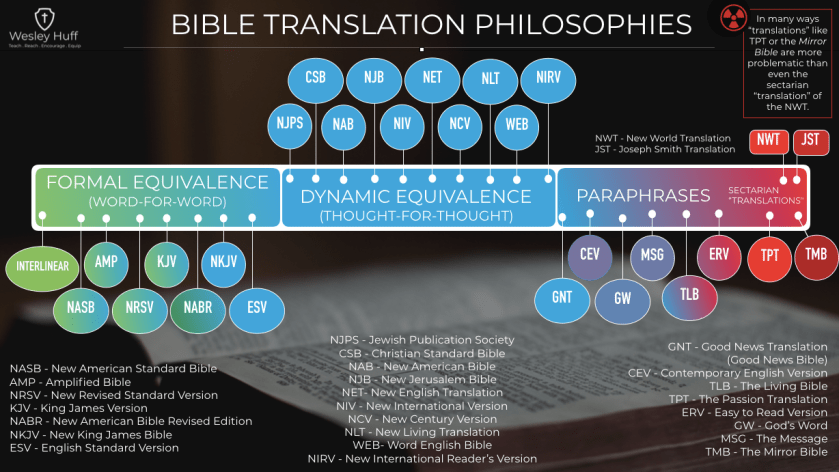
Bible translations fall along a spectrum (see the helpful charts and infographic below for details). For deep study, I focus on reliable versions that balance accuracy with readability.
Word-for-Word Translations (Formal Equivalence – prioritizing literal accuracy):
- Amplified Bible (AMP)
- Amplified Bible Classic Edition (AMPC)
- English Standard Version (ESV)
- King James Version (KJV)
- New American Standard Bible (NASB)
Thought-for-Thought Translations (Dynamic Equivalence – prioritizing natural, meaningful English):
- New King James Version (NKJV) – starts word-for-word but leans toward thought-for-thought for smoother reading.
- New Living Translation (NLT) – thought-for-thought but leans toward paraphrase for clarity and flow.
My Personal Favorites:
- The NLT is my go-to for general reading, devotional time, and everyday study – it’s engaging and easy to understand.
- For deeper, in-depth digging: KJV (especially the edition keyed to Strong’s Exhaustive Concordance with Hebrew/Greek/English), AMP, AMPC, and ESV.
Paraphrase Translations:
I mostly avoid these for serious study, as they involve more individual interpretation (see the “red danger zone” in the infographic below for why caution is wise).
I’ve included two handy Bible translation charts below to quickly show where common versions fall on the spectrum.
| Category | Translation I Use | Usage |
| Word-for-Word | AMP, AMPC, ESV, KJV, NASB | Primary for deep study; high accuracy to original texts. |
| Thought-for-Thought | NKJV (leans from word-for-word) NLT (leans toward paraphrase) | NKJV for readable accuracy; NLT for devotional/general reading. |
| Paraphrase | (None primarily) | Generally avoid for study due to added interpretation. |

Site Navigation
 Christ in You (Good News) Study Map